

Sophie Swords | July 28, 2025
Posted in: Blog, Investment Management, Technology
Top 6 Features Real Estate Investment Accounting Software Should Have
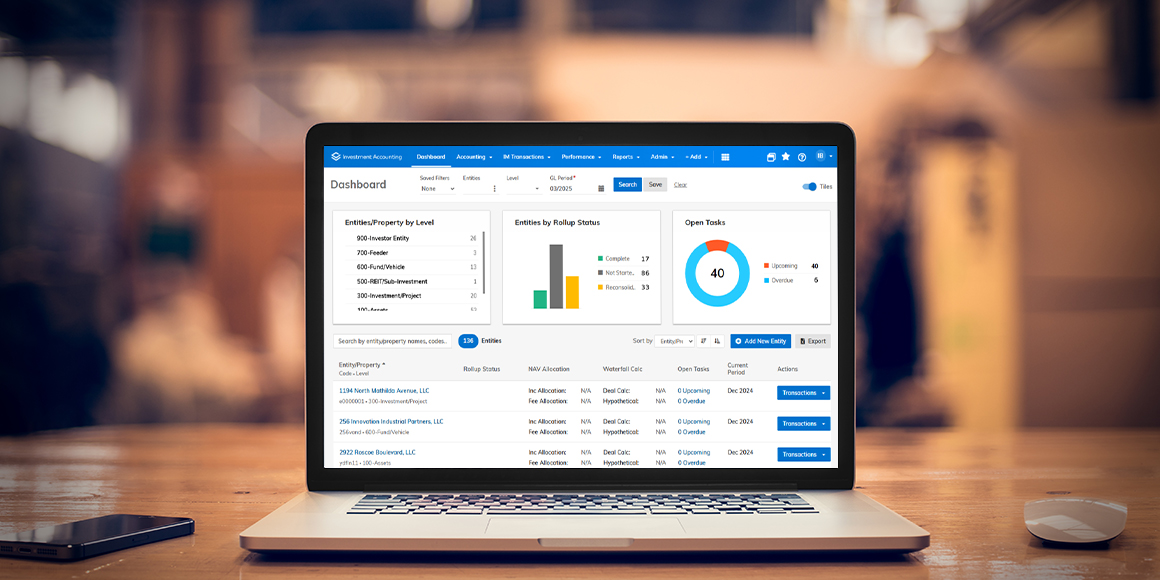
Managing complex real estate ownership structures is a challenging task. Intercompany cash flows, financial consolidations and investor reporting can quickly become overwhelming, especially for firms using outdated systems or manual processes. That’s where a dedicated real estate investment accounting system makes all the difference. By automating key financial processes, platforms like Yardi Investment Accounting enable companies to increase efficiency and manage their accounting tasks with minimal effort.
To maximise the benefits of such a system, here are the six essential features that real estate professionals should look for in investment accounting software.
1. Simplified Capital Calls and Distributions
Managing intercompany cash flows is one of the most time-consuming tasks in real estate investment accounting. From capital calls to distributions, fund transfers across legal entities must be tracked with precision and transparency. A dedicated software streamlines:
- Capital Calls: The automation of fund requests from investors to the asset level ensures proper allocation and real-time visibility.
- Cash Distributions: Efficiently manage excess cash flow from properties to investors, ensuring alignment with ownership structures, hurdles, and preferences.
Yardi Investment Accounting automates these processes across the ownership structures, creating seamless, error-free workflows that reduce administrative burdens and eliminate reconciliation hurdles.
2. Automated Financial Consolidations
Financial consolidation is a real challenge for real estate organisations managing multiple properties through layered legal entities. A robust accounting system automates consolidations, factoring in:
- Ownership Percentage Splits: Accurately reflects each stakeholder’s share in every transaction.
- Reporting Methodologies: Supports various frameworks, including Full Consolidation, Equity Pick-Ups, and Non-Controlling Interest.
- General Ledger Simplification: Consolidates data from individual entity ledgers into unified financial statements.
These functions ensure that your reporting process is accurate, comprehensive, and compliant, which is essential for maintaining stakeholders’ trust and enabling informed decision-making.

3. Investor Reporting Tools
Investor reporting is crucial for maintaining strong relationships with your investors and fostering their trust through transparency and accountability. With an investment accounting system, you can provide investor-centric reports that include insights such as fund performance at every ownership level, accurate cash flow projections, distribution waterfalls, and individual investor returns.
This level of transparency fosters confidence and strong relationships, positioning your company as a trusted investment partner. One of our clients, Unico Properties, reduced the time spent on reporting with Investment Accounting by separating investor reporting information from general accounting information, accommodating different transaction types on the same general ledger account.
4. Compliance and Risk Management
Another essential aspect of real estate investment management is ensuring regulatory compliance and maintaining records that are audit-ready. With comprehensive investment software, you can automate audit trails for every transaction accounting for complex ownership structures.
Platforms like Investment Accounting also provide compliance safeguards for intercompany dealings and financial reporting standards. By reducing human error and automating compliance workflows, solutions like Yardi’s mitigate risk, enabling your team to focus on strategic initiatives rather than tedious paperwork.

5. Scalable Platform
As your portfolio grows, so does the complexity of your accounting needs. Complex investment accounting software should be able to scale with your business, adapting seamlessly to expanding portfolios, larger investor bases and evolving ownership structures. Yardi Investment Accounting is built to do that. Whether managing 10 or 1,000 assets, the system handles high volumes of transactions, complex capital flows and ownership tiers, as well as advanced reporting, consolidations and distributions. For example, MG Properties Group added over 600 investors and 6,000 units across 12 new properties using the Yardi Investment Suite — without the need for additional staff.
6. Cost- and Time-Saving Automation
The goal of an advanced investment accounting system is to automate repetitive tasks and simplify complex financial processes, providing key benefits such as:
- Reducing administrative costs
- Eliminating time-consuming manual reconciliations
- Freeing up time to focus on strategic growth initiatives
The cost of licensing Yardi Investment Accounting is balanced by the time saved, errors avoided and enhanced investor satisfaction.
Conclusion
In today’s real estate market, efficiency in managing complex ownership structures is not just necessary but also a strategic advantage. Yardi Investment Accounting transforms financial operations by automating intercompany transactions, financial consolidations and investor reporting, all while delivering unparalleled transparency. This results in streamlined workflows, increased investor confidence and more time to focus on business growth.

Recent Posts
Similar Articles

Yardi x AREF: Exploring the Role of Data and Technology in Investment Decisions
Yardi partners with AREF on a new report, exploring how data and technology are influencing investment decision-making in real estate – take the survey now!

Effective Capital Raising Strategies for Real Estate Investment in 2025
Understanding real estate capital raising in today’s environment is key to unlocking long-term growth opportunities. We explore key strategies for successfully raising capital for real estate investments in 2025.

Simplify KYC/AML Compliance with Investment Manager
See how Yardi Investment Manager expands its functionality to capture, manage, and store all required investor data within the same platform.

Understanding the Main Types of Real Estate Investment Loans
Explore the main types of real estate investment loans, along with their structures, use cases, and strategic importance.